


NIPANIPA 이용자
아직 리뷰가 없어요.
리뷰 쓰기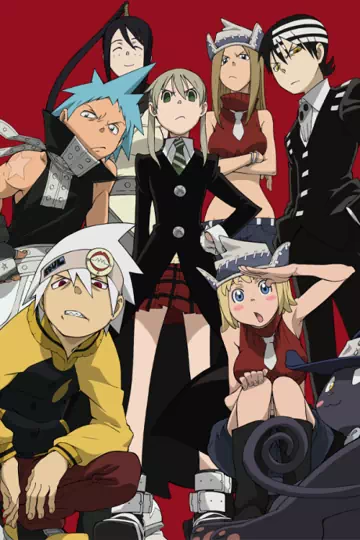
NIPANIPA 이용자
아직 리뷰가 없어요.
리뷰 쓰기AniList
77/ 100
Set in the Shinigami technical school for weapon meisters, the series revolves around 3 groups of each a weapon meister and a human weapon. Trying to make the latter a "Death Scythe" which is the highest title for a weapon and thus fit for use by the Shinigami, they must collect the souls of 99 evil humans and 1 witch.
Maka & Soul Eater, Black Star & Tsubaki, and Death the Kid with Patty and Liz Thompson are the characters Soul Eater revolves around. Besides taking the time to gather souls, these students of Shibusen defend Death City from some of the most powerful of creatures while still attending school and trying to become stronger.
출처: AniList · 영어 원문
 일곱 개의 대죄TV · 2014 · 72%
 일곱 개의 대죄: 분노의 심판TV · 2021 · 65%
 나루토 (애니메이션)TV · 2002 · 80%
 나루토 질풍전TV · 2007 · 82%
 블랙 클로버TV · 2017 · 79%
 FAIRY TAILTV · 2009 · 72%
 길드의 접수원인데, 야근이 싫어서 보스를 혼자 토벌하려고 합니다TV · 2025 · 66%
 페어리 테일 100년 퀘스트TV · 2024 · 75%
 EDENS ZERO 제2기TV · 2023 · 73%
 나의 히어로 아카데미아TV · 2016 · 76%
 원피스TV · 1999 · 87%
 나의 히어로 아카데미아 2TV · 2017 · 79%
Halloween and Anime together at last, Soul Eater is one of my favourite anime. Produced by Bones, who brought us Ouran High School Host Club, Darker than BLACK, and Wolf's Rain. Soul Eater is adapted from the manga by Ookubo Atsushi. It is of personal importance to mention the manga for the animer is a very close…
Halloween and Anime together at last, Soul Eater is one of my favourite anime.
Produced by Bones, who brought us Ouran High School Host Club, Darker than BLACK, and Wolf's Rain. Soul Eater is adapted from the manga by Ookubo Atsushi. It is of personal importance to mention the manga for the animer is a very close adaptation of the latter. In a nutshell, the story follows three students Meisters and their respective Demon Weapon partners, as they embark on a journey to combat evil, and yet grow up with each other at the same time.
Story (9/10) The plot follows a general plot-line really, with the Meisters and Demon Weapons going to school, equipping themselves with combat skills, so as to fight the forces of evil in the context of the show. Throughout however, we are treated to comedy and mere innocence from the characters - for they are really just kids trying to grow up - so Soul Eater as a show generally turns out to be quite the light-hearted pick. Nevertheless, there are episodes which tug at the strings of the heart, where the emotions of the characters really reach out to you, and also episodes which are pure comedy, where you inevitably laugh at the zaniness of the world.
Music (10/10) Produced by Iwasaki Taku, of Tengen Toppa Gurren Lagann anime. Responsible for tracks in the latter, like Libera me from Hell and FIGHT THE POWER, he delivers as well in Soul Eater. The music fits the mood perfectly, fighting and comedy scenes are complimented by their music, and I really believe he does a good job here.
Art (8.5/10) One of Soul Eater's strongest selling point. Bones did really well animating the fight scenes in the manga, and the colours are so rich and beautiful, that every episode is a joy to behold. The drawing of the characters are good but these are pretty normal, I must say. It is the sketches of the environment, and the animation that really stands out. Soul Eater was the anime which spoiled me in terms of fight scenes.
Characters (10/10) Another strong selling point and you will find yourself liking some of them more than the others. The Protagonists are interesting and fun to watch, we have ranging from the slick yet ridiculously symmetry compulsive and the son of Death, Death the Kid, to a goofy kid who wants to be the strongest but cares for his friends, Black Star, and we have a bright pigtail girl likes to give Maka Chops to her dad, Maka Albarn. Soul Eater provides characters which are strong enough to carry the series on their own backs. Even the Antagonists are interesting, you cannot help but like them. Powerful, and pretty witches make up the cast of the latter and it is quite fun to watch the inner dynamics where they manipulate each other for their own benefits.
Nevertheless, Soul Eater is a great show for all its strengths in animation and music. Its light-hearted tone throughout is also ideal for those who seek to enjoy the anime after a tough day at work or school. There is no need to think too much about plot implications (apologies if you are a sucker for these), Soul Eater allows you to just sit back and gawk at the wonders of the supernatural. Definitely a show worth your time.
If you’re a fan of the nineties stop motion movie The Nightmare Before Christmas, your vision of a land based entirely on the tropes, designs and conventions of Halloween is a dark, depressing town where every single resident is ironically joyful and pleasant towards one another. Soul Eater, on the other hand, takes…
If you’re a fan of the nineties stop motion movie The Nightmare Before Christmas, your vision of a land based entirely on the tropes, designs and conventions of Halloween is a dark, depressing town where every single resident is ironically joyful and pleasant towards one another. Soul Eater, on the other hand, takes this idea and turns it over on it’s head. Death City, for all of it’s creeps and ghouls, is a bright, happy place where even the Grim Reaper is more of a cuddly uncle than a terrifying specter of doom. The Reaper, or Lord Death, as he prefers to be called, is the headmaster of the Death Weapon Meister Academy, a school that teaches young people how to join their souls to protect the world from witches!
To do this, one student must become a living weapon, and their chosen partner must wield them against creepy, devious witches who hide in the shadows and… Do stuff, like transforming into all manners of creepy creatures! Once each team has devoured the souls of 99 corrupted humans and one witch, they will be advanced to the status of Death Scythe, the preferred weapons of Grim Reapers everywhere. But one witch has decided to take matters into her own hands… She plans to awaken an ancient, sleeping demon that will drive the entire world past the brink of insanity! Can Meister Maka, her weapon Soul, and their friends stop this plan before it’s too late, or will the world lose itself to the clutches of chaos?
The animation studio behind this heaping helping of Halloween was Studio Bones, the studio that gained fame from Fullmetal Alchemist and Wolf’s Rain. Like the majority of their projects, Soul Eater has solid, kinetic animation… About half the time. The animation is never quite as smooth or expensive as it is in the first season opening, but it is more or less solid for the most part. There are a few embarrassing moments, such as where characters look like their walk cycles were just copied and pasted onto the environment, but thankfully, they’re few and far between. What’s NOT few and far between are the still shots. There are several occurrences where a character is talking, but the camera is focused on the environment, other character’s faces, or just the eyes of the speaker, leaving the lip flaps off screen.
There are a lot of action and fighting scenes throughout this series, and the fact that most of the budget is saved for those scenes is a life saver in the long run. The editing and angles can be a bit too amateurish and generic for their own good at times, and there are way too many close-ups of characters’ faces, but it works over-all. The character designs are it’s best visual aspect by far, although the highly detailed backgrounds are also noteworthy. There was so much inspiration and creativity in the aesthetic of this series that even the Grim Reaper is like no other reaper you’ve ever seen before.
Aside from a couple of female background characters who are retroactively given names and identities in the later episodes, every single named character is given a unique and unforgettable look that goes beyond just their hairstyles and fashions. Some of them are grounded, some of them are insane, and you can tell instantly which witches are based on which animals. If you haven’t seen the anthropomorphic version of the legendary sword Excalibur… Think Puttin’ On the Ritz from AMV Hell 5… You would never guess what he looks like or acts like in this series, as he has one of the most insane gimmicks in a series full of insane gimmicks.
The music… I think existed? Well, that’s not fair. The music is decent in this series, but for the most part, it does it’s job in the background, rarely ever calling attention to itself… Which is good because trust me, a lot of it’s tracks are reused over and over again through the series. Besides, who cares about the score when you’ve got such amazing opening and closing songs? The first opening is called Soul Resonance by TM Revolution, and it’s the kind of high energy, i
The twisted city, the grinning moon, the first opening's ridiculous background animation... My memories of Soul Eater were all distinctly visual before I got to rewatch it, and it makes sense: it's probably the most stylish show of its kind. With an impressive amount of visual flair for a TV production, it feels like…
The twisted city, the grinning moon, the first opening's ridiculous background animation... My memories of Soul Eater were all distinctly visual before I got to rewatch it, and it makes sense: it's probably the most stylish show of its kind. With an impressive amount of visual flair for a TV production, it feels like everyone in the team knew exactly where to take the aesthetic and had the resources to take it there.
A very interesting thing about Ohkubo's manga is just how much it wears its influences on its sleeve. Visually, it feels like The Nightmare Before Christmas by the way of [Jamie Hewlett](https://imgur.com/gallery/bjfsG), but there's a lot more to it. References to pop culture from all over the world plague the setting, and not just as side gags. We get to see the Red Room, all sorts of fairytales, urban legends an even real figures (from Al Capone to a katana-wielding bodyguard who shares his name with legendary actor and absolute daddy Toshiro Mifune), all seemingly thrown in without a second thought. It works, though, both because of how far it goes and thanks to stellar presentation, which involves every element going through a sort of urban filter. Manga wise, it's only a thing in chapter openers and the occasional SOL bit (I recommend [Soul Eater: Soul Art](https://www.youtube.com/watch?v=75J_r3kqFt4) for a nice look into it), but the anime cranks it up to eleven and makes it a core part of both its [sound](https://www.youtube.com/watch?v=k13PRRNEqo8) and [visuals](https://www.youtube.com/watch?v=6W1ajuerl6o).
Yoshiyuki Ito's [designs](https://setteidreams.net/settei/soul-eater/index.php?pic=116.png) bring the characters to life with better shapes and expressions than ever, while the background art (bless [Norifumi Nakamura](https://www.animenewsnetwork.com/encyclopedia/people.php?id=35553)) frames one iconic image after another and Taku Iwasaki delivers [some of his best musical work](https://www.youtube.com/watch?v=feVmEWyAauM) in service of the show's chaotic tone. And it *is* chaotic, never dwelling in any given mood for over five minutes, but it's also consistent. There seems to be a widespread idea among many anime fans -and media critics in general- that a consistent tone needs to be continuous throughout the entirety of a work, but it couldn't be further from the truth. Drama and comedy are usually intertwined and not merely coexistent. The show respects its characters by letting their extremely cartoony personalities affect the plot without any restraint, closer to PCs in a D&D campaign than your average main characters in a traditionally linear story. It gives them presence and charisma in a way not too different from Dorohedoro or Chainsaw Man. Granted, some of the show's jokes are in pretty bad taste and it *can* interrupt the action sometimes, but it's never enough to overcome its sheer attitude.
Every storyboard is exaggerated past the breaking point. Soul Eater's world can only be observed through [fisheye lenses and absurd perspectives](https://www.monsterlibrarian.com/ReadingBites/wp-content/uploads/2015/12/Maka_Albarn_Anime_-_Episode_1_-_7.png), with no shot left behind. Close-ups are detailed and expressive, establishing shots are imposing and every meister has the natural ability to always appear in a cool low-angle. Grins go from ear to ear, the moon *bleeds* and the weapons twist taking up as much of the screen as the scene requires. [Sakuga](https://www.sakugabooru.com/post/show/111284) is frequent. The anime is so committed to its own idea of being cool that it only took me a couple of episodes to be 100% along for the ride and invested in the characters.
The story itself was what I was most afraid of; everytime I talked about it with someone I was told to beware. It was a complete mess, apparently, and the already senseless story culminated in the worst possible ending. Fortunately that couldn't be further from the truth. It's not only that the presentation elevates it: even if yo
_Soul Eater_ introduces a type of shōnen full of satire and self awareness while also giving depth to the three main characters with their sidekicks/weapons introduced separately in each of the first three episodes: Maka, Death the Kid and Black Star. The premise of the show given in the 1st episode is an intriguing…
_Soul Eater_ introduces a type of shōnen full of satire and self awareness while also giving depth to the three main characters with their sidekicks/weapons introduced separately in each of the first three episodes: Maka, Death the Kid and Black Star. The premise of the show given in the 1st episode is an intriguing one. Collect 99 souls of evil humans and 1 witch's soul so that their weapon can become a death scythe which is to be used by Death. Too bad they completely forgot about that idea as the show continued. As the show goes on, it falls into the cliche shōnen tropes it was making fun of in the 1st half of the show. The tropes or setbacks they gave to the main characters were actually very funny. Maka and her weapon, Soul's, constant arguments with each other, Kid's obsession with symmetry and Black Star's arrogance were used perfectly. It didn't feel like it was forced nor was it annoying or used as a cheap gag which it would be later in the series.
The tone of the series shifts from satirical while telling a story I was invested in to a straight shonen cliche and all the intelligence that I felt was behind the first half of the show was left behind by the second half. Shrouded in seriousness and dread with cheap comedic relief in moments Soul Eater felt like a drag to get through.
The characters were the most annoying part of the series for me especially since they started off as the best part of the series in the first half. Death the Kid's OCD was completely forgotten about unless they need some comedic relief, Maka became a spoiled brat and Black Star's charm was wasted by not being given proper development to his character in the second half of the show. A lot of topics teased on the show were completely forgotten or weren't properly explored. For example: Maka's relationship with her father and mother, Black Star's relationship with his clan and his progression to mastering his weapon. A lot of characters weren't given arcs that i think they deserved such as Spirit Albarn, Franken Stein, Maka's scythe (Soul Eater). They only glossed over Soul not liking his family name, I definitely would have liked his origins to have been explored. Plus Maka's mother was foreshadowed as this mysterious but incredibly powerful meister but she wasn't even shown once in the show. If she was such an important character in terms of power why didn't she come to help when the world was being destroyed?! SIDE NOTE: the voice acting in this show (I didn't watch the English dub) was incredible. Kudos to the actors.
The visuals are one thing I can commend the show wholeheartedly on. Soul Eater was animated beautifully and the fight scenes were spectacular. Though there weren't many long ones in this show. Black Star wasn't given enough battle scenes in 51 episodes when he was the one could have had the most stunning fights visually. The show only gives glimpses of the heights they could reach in a Black Star fight but doesn't fully invest in them in terms of screen time. The only fight that gave my eyes what they wanted was the fight between Black Star and Asura. Though when he was getting ready to fight Asura (after he got decreased from his giant monster form) the show cuts to Maka's uninteresting journey to save Soul from the demon. When they cut to Asura we see Black Star defeated. The fact that they didn't show the fight was very disappointing because it could have given Black Star his proper light.
Soul Eater isn't the worst show out there. It's far from it. My disappointment lies in the potential, promise and intelligence it had in the first half which all got reduced down to a mediocre shonen anime.
Uma das minhas maiores dúvidas desde que comecei a ver animações japonesas é o que faz um Battle Shounen ser bom. Ter ótimas lutas? Apresentar uma história épica? Possuir personagens marcantes? Talvez fosse tudo isso junto de forma coesa? Bem, Soul Eater definitivamente não tinha tudo isso nessa escala de qualidade…
Uma das minhas maiores dúvidas desde que comecei a ver animações japonesas é o que faz um Battle Shounen ser bom. Ter ótimas lutas? Apresentar uma história épica? Possuir personagens marcantes? Talvez fosse tudo isso junto de forma coesa? Bem, Soul Eater definitivamente não tinha tudo isso nessa escala de qualidade para entregar, mas ele possuía algo que proporcionava uma experiência completamente única para mim: _"A sua própria identidade dentro de um gênero tão inautêntico como é o Battle Shounen!"_
Soul Eater conta a história de uma escola fictícia chamada Shibusen, criada com o intuito de combater e eliminar os ovos de Kishins, que são seres que devoram almas humanas para se tornarem mais poderosos, e as Bruxas, que vivem aterrorizando o mundo. Os encarregados de eliminar esses seres são os artesãos, que além de eliminar os Kishins, devem ajudar suas armas a se tornarem Death Scythes, para o Shinigami usar como sua própria arma. Os artesãos devem fazer suas armas devorarem um total de 99 ovos de Kishin e uma alma de bruxa para serem uma Death Scythes. O anime tem início com três prólogos, onde cada um conta a história dos personagens principais e como funciona a mecânica de artesão e arma. O primeiro episódio apresenta a Maka Albarn, artesã da foice, e seu parceiro arma, Soul Eater Evans. O segundo apresenta o Black Star, um artesão com técnicas de assassinato, e sua parceira arma, Tsubaki Nakatsukasa. Por fim, é apresentado também o filho do Shinigami, Death the Kid e suas duas parceiras: Patti Thompson e Lizzy Thompson. O anime foi produzido pelo estúdio Bones e estreou em março de 2008 na TV Tokyo. Ele possui 51 episódios, dos quais tomaram um rumo diferente do mangá em sua reta final.
Dada a explicação de sua premissa, é necessário avisar que essa review contém spoilers de determinados pontos de Soul Eater que podem comprometer sua experiência. Por sua conta em risco, prossigamos com a análise começando pela sua trama.
De começo, é difícil entender qual será o rumo que sua trama irá tomar. Ao que nos é apresentado durante os prólogos, a proposta parece ser voltada para que os artesãos tenham sucesso em transformar suas armas em Death Scythes. Porém, esse conceito é rapidamente deixado de lado, abrindo espaço para uma trama mais dispersa no começo, onde poucas coisas te indicam um rumo definitivo, mas aos poucos as situações que eles acabam passando vão formando o que vem a ser a trama central de Soul Eater. Ela não é inovadora, muito menos rotineira, se encaixando mais num meio termo entre os dois, porém a forma como é trabalhada desperta muitos elogios para sua escrita. Soul Eater é mais um que se utiliza da estrutura narrativa que já vimos em vários outros animes do tipo Battle Shounen, porém com a grande diferença de ter uma trama bem mais descompromissada que o normal do gênero. Mesmo que em determinados pontos ainda tenham seus momentos de seriedade, a obra sempre acaba recorrendo ao uso de piadas com intuito de quebrar qualquer tensão que possa ser criada em cada cena. Isso pode parecer algo problemático, mas é exatamente aí que está um dos maiores charmes de Soul Eater. Ele não se leva a sério, e nem tem a intenção de criar uma tensão com aquelas situações abordadas, mas sim de poder inserir seu estilo de comédia mais escrachada para tirar qualquer peso de seu público, apoiando-se muito em sua excentricidade para realizar tal feito. Por sua vez, clichês e fórmulas tão criticadas dentro do gênero podem aparecer nessa forma de estilo de comédia sem comprometer a experiência, sendo completamente capaz de qualquer um ignorar tais pecados, pela forma como são abordados auxiliarem o tom cômico que a narrativa da obra trás. A partir de certo ponto isso muda, porém ainda não chegamos a essa parte da análise.
Com enorme mérito, o maior acerto de Soul Eater é o quão estiloso ele é e a identidade visual que ele expressa. Sua estética é completamente única pela sua primorosa mistura de inspirações, sendo bem visíveis de





 Narrator





















아직 글이 없어요. 첫 글을 남겨 보세요.
내 시청 상태