NIPANIPA 觀眾
還沒有評論。
撰寫評論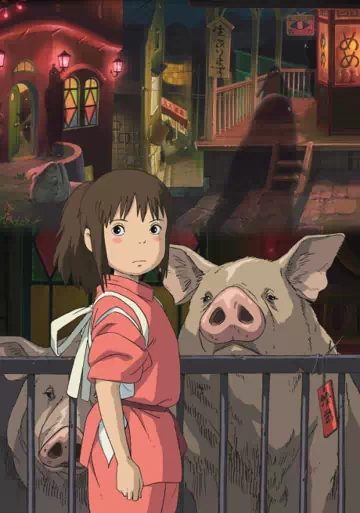
NIPANIPA 觀眾
還沒有評論。
撰寫評論AniList
86/ 100
前往新家的途中,10歲的荻野千尋一家偶然走進一座荒廢的主題樂園。全家人受到好奇心驅使,開始探索園區,卻不知道這裡暗中住著白天沉睡、夜晚現身的神靈。千尋的父母吃了街邊餐館的食物後,憤怒的神靈便把兩人變成豬。此外,神靈世界與人類世界之間突然出現一片廣闊的海,讓身為唯一人類的千尋困在神靈的國度。幸好,一名叫作白龍的神秘少年出現,聲稱過去就認識千尋。在他的指引下,千尋在白龍工作的澡堂找到一份工作。千尋只能靠著勇氣和新結識的朋友,踏上讓父母恢復原狀並回家的旅程。
來源: AniList
It almost feels unnecessary for me to review this movie. Everybody knows about it. Everybody (who knows what they’re talking about) knows it’s a masterpiece. Is there really anything else I can add to the discussion surrounding this movie? No, but I still wanna talk about it anyway because I love this movie & actually…
It almost feels unnecessary for me to review this movie. Everybody knows about it. Everybody (who knows what they’re talking about) knows it’s a masterpiece. Is there really anything else I can add to the discussion surrounding this movie? No, but I still wanna talk about it anyway because I love this movie & actually have yet to review a Studio Ghibli movie. But first a little history. I originally watched Spirited Away for the first time back in 2018 a few months after I had just gotten into anime proper & knew who Hayao Miyazaki was. More importantly though, I knew the reputation this movie had going into. I watched it….. & I liked it. I’ll be honest I wasn’t overly impressed with it or saw why it garnered its reputation, but I enjoyed the film overall. Though I did watch it the same day I watched Akira for the first time, which at the time, I thought was a completely incomprehensible piece of shit. That stance has changed since then but the point is, I would’ve thought anything was good coming off Akira the exact same day I watched it. Going forward in life I just kinda moved on & didn’t think about Spirted Away too much. But in 2019 as I realized I was running out of Studio Ghibli movies to watch (as in I was close to seeing all of them). I went on a sort of Ghibli binge & started to not only watch the ones I missed, but even rewatched some of my favorites/ones I wanted to get a new opinion on, & thus brings us back to Spirted Away. I rewatched it….. & I fucking loved it. Whatever prevented me from really seeing Spirited Away as a masterpiece back then no longer applied, I was enthralled with movie & for a week I couldn’t take my mind off of it. I know this introduction was rather lengthy but I honestly felt this was necessary because I wanted to apply some groundwork as to why this is now my second favorite, & at times my favorite Miyazaki movie of all time. Spoilers inbound btw
I think what I love most about Spirited Away is the narrative, but more so the narrative structure. I love coming of age stories & Spirited Away is one of the best in my honest opinion. Chihiro does start out as an unlikable brat, but what do you expect? She’s only 10, has to move away to a different town from all her friends, & then gets thrusted into this fantasy world that she knows nothing about, & on top on top of that, is filled with all these weird fantasy creatures that nobody knows about. But throughout the movie we get to see Chihiro adapt to this environment. We see her overcome these impossible odds. We get to see her grow up. It’s simplicity executed to perfection & what makes this story even better is the storyboarding. If there’s one thing Hayao Miyazaki is a master at it’s crafting/mapping settings. I won’t bore you with excessive details like how Chihrio exactly got from outside the bath house to Yubaba’s room. But I feel like if Yubaba’s bath house was a real place that I could visit I would know the layout exactly & wouldn’t have to consult anybody thanks to Miyazaki’s storyboarding. The world just builds together & flows so fluently that I was never lost, I knew exactly where I was at all times. But even better is the pacing. This movie is just right, it knows exactly how long it needs to stay somewhere, it knows exactly when to transition into the next scene, & it knows how to keep me engaged & never question how much longer I have left in the movie. This movie is 2 hours long but I was never bored because of how excently paced the movie was. What else needs to be addressed is the world building. I more or less alluded to it when talking about the storyboarding but can we take a moment to appreciate how meticulously crafted this world is? From the pig farms, the market where Chihiro’s parents turn into pigs, the aforementioned bathhouse, Yubaba’s office & her baby’s room. The train station that takes Chirio & No Face to Zeniba’s hut in the swamp. I remember everything about this world precisely because of the excellent world
Moving away can be a tough situation, especially when you’re still a child. Your parents probably have a good reason to relocate… Changes in the economy, lucrative opportunities at work, declining property values and rising crime rates… But how is that supposed to matter to you when you’re being uprooted from your…
Moving away can be a tough situation, especially when you’re still a child. Your parents probably have a good reason to relocate… Changes in the economy, lucrative opportunities at work, declining property values and rising crime rates… But how is that supposed to matter to you when you’re being uprooted from your routine, removed from the home you’ve grown attached to, and being forced to say goodbye to your friends? Anybody in that situation would be bummed out, and Chihiro is no exception, sulking in the back of her family car, hugging the one reminder she has of the life she’s leaving behind, a bouquet of flowers. There’s nothing she can do but pout as her family gets closer and closer to their new home, but when her well-meaning father takes a shortcut and winds up getting them lost, that sense of worry and disappointment gives way to something far more ominous.
At the end of a lonely, suspiciously unpaved path, past a wasteland of ancient shrines, Chihiro and her family are stopped in their tracks by an old statue outside of the mouth of a tunnel. Guided through said tunnel by sheer curiosity, Chihiro’s parents wander through it, with their reluctant daughter in tow, and what they find on the other end was more than they could have possibly imagined. Thinking the structures at the other end to be an abandoned theme park, her parents find a booth of fresh food, which they almost immediately begin to chow down on, even as the whole world seems to go to hell around them. As the park’s true inhabitants begin to make their ghostly selves known, Chihiro’s parents are turned into pigs, and the terrified girl suddenly finds herself stranded alone at a bathhouse for wayward spirits, and if this unwitting stowaway wants to have any chance of rescuing her folks and escaping this supernatural spa of spooks and spirits, she’ll have to leave her spoiled, selfish upbringing behind and grow up fast under unforgiving circumstances.
This is only the second Studio Ghibli title that I’ve reviewed(Yes, this is the first one I’m posting… remember, I do things weirdly), and it couldn’t be more different from the first one. To start, this film was actually directed by Hayao Miyazaki himself, and not by the recently departed Isao Takahata, and you can tell the difference from the visuals. It’s worth mentioning that in some of Ghibli’s films, the animation budget is, perhaps, much higher than it needs to be, as there isn’t always much going on in terms of action, and aside from the obligatory flying scenes, some of their work can skew heavily towards realism. In Spirited Away, however, the animation is just as fluid and lavish, but it’s being used for so much more. Studio Ghibli doesn’t really have any bad looking films, with even it’s lesser titles at least being nice to look at, but even among a filmography that’s full of beautiful artwork and vivid animation, Spirited Away still manages to be right up near the top as one of their best looking, if not THE best looking, titles ever released by the prolific studio.
In any Ghibli title, you’re going to be able to expect a very high visual standard, consisting of… At the very least… Fluid animation, graceful character movements, expressive faces, and highly detailed, immersive environments. Spirited Away has all of these, but it also adds so much more that helps it to stand out among it’s peers. The bathhouse, as well as the spirit town surrounding it, is a huge setting with no shortage of different locations to explore, and every single inch of it that we’re allowed to see is rich with detail and personality. The cast of characters, from the main ones all the way down to the hundreds of spirits inhabiting the area, are incredibly diverse, offering enough unique designs to fill out an entire here’s Waldo book, and while a ton of them were obviously pulled from Japanese mythology, they’re still drawn in such a way that the youngest of viewers probably won’t be afraid of them. They also all have t
I'll never forget October 28, 2018, for two reasons. The first is that it was my 20th birthday. The second is that it's the day I went to see a movie. It was a movie I already owned on Blu-ray and had seen several times, but that couldn't dull my enthusiasm. The movie in question was, of course, Hayao Miyazaki's…
I'll never forget October 28, 2018, for two reasons. The first is that it was my 20th birthday. The second is that it's the day I went to see a movie. It was a movie I already owned on Blu-ray and had seen several times, but that couldn't dull my enthusiasm. The movie in question was, of course, Hayao Miyazaki's _Spirited Away_, a film notable for being not only the only piece of Japanese animation but also the only hand-drawn animated film to win an Academy Award for Best Animated Feature. More than that, _Spirited Away_ is that rare Oscar winner that actually lives up to its hype. Miyazaki has crafted an ode to the best parts of the human condition that masterfully explores fear and how to overcome it, the follies of greed and gluttony, the importance of compassion and selflessness, the importance of friendship, the true definition of bravery, and the triumph of the human spirit, all through the eyes of a child. The result is one of Miyazaki's most intensely satisfying films, one that many consider his finest hour even some 20 years after its arrival in Japan, and one that this Miyazaki fan certainly counts among his favorites.
10-year-old Chihiro Ogino (Daveigh Chase in the 2002 Disney dub, Rumi Hiiragi in Japanese) is not at all pleased with the fact that her parents Akio (Michael Chiklis, Takashi Naito) and Yuko (Lauren Holly, Yasuko Sawaguchi) have decided to move to the middle of nowhere, not wanting to leave her friends behind or to have to deal with a new school that's "gonna stink." As if that wasn't enough, however, Akio takes a wrong turn and the family ends up in front of a creepy tunnel rather than at the door to their new home. Moreover, Akio decides he wants to see what's on the other side. When Akio and Yuko stuff themselves on some unknown food at an oddly empty restaurant and mutate into pigs, it seems like Chihiro's situation can't get any worse. However, a boy named Haku (Jason Marsden, Miyu Irino) gives her carefully laid-out instructions on how to survive in this ghostly world. First, she must ask Kamaji (David Ogden Stiers, Bunta Sugawara), the six-armed man who operates the boiler, for work. Since Kamaji already has all the help he needs, he has Lin (Susan Egan, Yoomi Tamai) take Chihiro to see Yubaba (Suzanne Pleshette in her final film, Mari Natsuki), the witch who rules the bathhouse. The sorceress first tells Chihiro to leave, playing up her scare tactics but Chihiro, not one to hang her parents out to dry, persists, informing Yubaba right up front that she won't leave without a job. Yubaba concedes, but not without taking Chihiro's name, giving her the name Sen, and beginning to drain her memories, a process Haku soundly annuls the next morning by returning Chihiro's name. He also warns her that she won't be able to go home if she completely forgets her name, recalling that he can't remember his own name. This doesn't spell a sudden end to Chihiro's troubles in the spirit world, however. Aside from Lin, the other workers in the bathhouse look down on Chihiro with what can safely be called genuine disdain. Not only that, but Chihiro will also soon have to deal with a polluted spirit, a gluttonous No-Face, and even Yubaba's identical twin sister Zeniba (Pleshette, Natsuki) on her way to rescue her parents.
Goodness. Two decades later, and we're still talking about _Spirited Away_. One of the foremost reasons is its storytelling, Miyazaki stuffing the film, all 124 minutes of it, with enough heart, depth, and meaning, and, yes, enough thrills and light scares, that it's nigh-impossible not to get swept along in the depths of Chihiro’s ghostly adventure. Each character has either a story or a purpose, often both, and none come off as superfluous to the film, including a money-grubbing frog. It's perfectly understandable why Chihiro isn't happy with the move. She has friends in her old home, friends she doesn't want to leave behind, and it's not like she's grousing for nothing. When I was 10, I know
_Spoilers for the film. TL:DR, go see it if you somehow haven't already. It's great. _ As previously mentioned, I never grew up with Studio Ghibli films, so my experience with Miyazaki animes are not based in any childhood nostalgia, and instead come from more recent viewings of _My Neighbor Totoro_ and _The Castle of…
_Spoilers for the film. TL:DR, go see it if you somehow haven't already. It's great. _
As previously mentioned, I never grew up with Studio Ghibli films, so my experience with Miyazaki animes are not based in any childhood nostalgia, and instead come from more recent viewings of _My Neighbor Totoro_ and _The Castle of Cagliostro_ as an adult. That being said, its hard not to develop a kind of understanding of Miyzaki's style through pure cultural osmosis due to his influence on the industry as a whole, and while watching _Spirited Away_, even I, a relative newcomer to anime, could see the marks he had left behind.
Over a decade after _Totoro_, much has changed and much has also stayed the same. Like _Totoro_, _Spirited Away_ thematically deals with concepts of environmentalism, the interaction between humans and nature, and most prominently, a bunch of mythological Shinto creatures running around all over the place. The film oozes creativity and has the courage to let itself be odd and magical for the sake of it; the world in which Chihiro finds herself in is strange and doesn't make sense, and there is a mystery and wonder that comes from the story never bothering to explain why or how most things are the way they are. It's the kind of fantastical and fun worldbuilding that can be hard to get away with outside of surrealist narratives. I also like how the spirit realm kind of works as a parralell to Chihiro's life at the beginning of the film; she's moving to a new place and isn't really excited about having to adjust...only to end up going someplace new where she has to deal with a lot more than just a new school.
_Spirited Away_ also seems to be gesturing towards anti-consumerism ideals or at the very least anti-greed ideals. The obvious examples here are how the plot is put into motion by Chihiro's parent's gluttony for food that isn't theirs turns them into literal pigs, or how the bathhouse spoils No-Face with food for his riches, leading to catastrophe. This is not to mention the characterization of Yubaba as gem collecting, industrial business owner and how she is contrasted with her twin sister, who lives in a humble swamp shack and is shown to be generally good. While the through-line was a little unclear to me, it also seems like Chihiro's heroism comes from the fact that she gives the herbal...you know that green ball thing she gets from the water spirit to Haku and No-Face to treat their ailments, even though it is implied that it has the power to return her parents to normal; Chihiro decides to put the needs of others before her own desires.
The film looks amazing, but you knew that already. What's most interesting to me about it, is that comparing it to _Totoro_ the actual art style doesn't seem too different or updated, it more just seems like everything from the line art to the animation has been refined to look cleaner. Not a bad thing by any means; it makes for an interesting visual flair of 70-80's aesthetics aided by early 2000's technology.
My favourite character was Kamaji; he's not a huge part of the story but I think his role as the boiler room guy and chaperone to an army of dust bunnies for this hyper-complicated bathhouse is a rare sight into how if we did ask for answers from Spirited Away they would be more confusing than the questions. Though for the most part I think I just like his arachnid Dr. Robotnik character design. And he's a sweet guy underneath it all.
I really enjoyed _Spirited Away_. Of the Miyazaki films I've seen (which isn't saying much, it's now only three) it might just be my favorite. I'll never be a kid again, but this film did inspire a smile in me, a kind of wonder for worlds unseen and unknown, a desire to think creatively and beyond the scope of how stories are usually told. I'd recommend it, but I bet a lot of you have already seen it.
The very facet of childhood can be boiled down to the very definition of mysterious wonder and awe-inspiring imagination. We’ve all had those moments where we would go off into our little world of childlike imagination and try to experience an entirely new reality different from our own. Films have attempted to…
The very facet of childhood can be boiled down to the very definition of mysterious wonder and awe-inspiring imagination. We’ve all had those moments where we would go off into our little world of childlike imagination and try to experience an entirely new reality different from our own. Films have attempted to recapture the atmosphere that resembles this nostalgic feeling of going through the childhood journey that either succeeded or failed. It just takes a man like Miyazaki to do just that flawlessly.
Miyazaki isn’t a stranger to making movies about childhood and things similar to its nature; Totoro would be an obvious example of this fact. He certainly has an eye for making these kinds of stories that his movies could reflect everyday childhood experiences that we have since grown out of and are now living in a fantastical world. The fantasy elements that are a constant staple of the Miyazaki lore have made most of his movies unique to many people, including myself, because of their originality and inventive folklore. Now, that isn’t to say that I’m the biggest Miyazaki fan as much as the next person. However, if there is one film that could never lose its imaginative and beautiful vision in his filmography with each passing viewing, Spirited Away would win at no contest.
In describing what kind of story Spirited Away follows, coming-of-age would be the most logical way of putting it. In that, we follow our main protagonist Chihiro and how she handles certain situations that would prove to be difficult for any other young person such as herself. When she first encounters this Spirit World, she is lost, hopeless, and confused. Not knowing what will happen to her or her parents after being turned into pigs, she finally finds help from other characters willing to help her be acquainted with this world, unlike her own. Once she is acquainted with the Spirit world, we now see her as a strong individual once she is more aware of her surroundings and can take care of herself without the help of Haku. It is by the end of the film an essential point to what makes not only Chihiro a fantastic character but also how Spirited Away paces its story structure.
Art and animation are nothing but superb in Studio Ghibli’s legacy in how they incorporate more emphasis on impressionist-inspired backgrounds with traditional hand-drawn animation. The scope of Miyazaki’s artistic vision is vast and organic in each of his films, and some other Ghibli films not directed by him sometimes lack minimal detail. Spirited Away may not have the most extensive scope in terms of scale, such as his previous films Nausicaä or even Princess Mononoke. I would argue the minimal scope works magnificently with the show’s structure. From the wonderfully drawn buildings to the tiniest detail of rust and wood splinters to the hypnotic waters surrounding the spirit world, it complements Miyazaki’s ascetic vision and Ghibli’s artistic talents exceptionally well.
Regarding the art, the one aspect of it that Spirited Away shines on the most is its creative art designs of the characters of each spirit you come across. They look original and not thought of from the previous animation, despite most of them being inspired by Japanese folklore. It’s not as if most of them are forgettable the minute after you see them. They all stick with you as you go along with the film, how impressive and imaginative the art design is even years after you finish it.
To describe how the character Chihiro is treated, as in how she is portrayed in the film, it would be essential to realize how Miyazaki wrote her as to how a real child would act. You’ve probably seen kids that behave like Chihiro, or you may have been like here at her age, and that behavior would be considered “bratty” or “immature.” But these shouldn’t be seen as negatives since, realistically, kids are at her age, as you see Chihiro before she goes to the spirit world. We see Chihiro go through hardship when she arrives


還沒有文章。來發表第一篇吧。
我的狀態